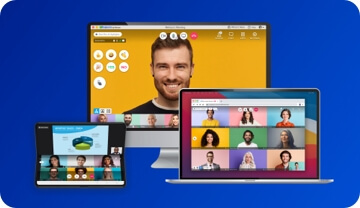
Learning in the Comfort of Blue Jeans
These are exciting times in education, as schools across the globe are asking how they can shift into the 21st Century.
21st Century learning environments aim to provide students the skills that will enable them to use technology as a vital tool for learning and prepare them to excel in an increasingly complex global future. As educators work to advance curriculum into the new age, many schools face tighter budgets. Teachers are urged to use new tools and technology to increase productivity, differentiate curriculum and help students develop non-cognitive & soft skills.
Benefits of using Blue Jeans for education:
1. ENHANCE LEARNING OPPORTUNITIES
- 80% of administrators, policymakers and educators indicate that interactive video conferencing is helping schools achieve academic goals1
- Students working full-time are the largest percentage of students (27%) taking distance learning courses2
The use of video conferencing within the education industry is rapidly advancing the effectiveness of knowledge transfer and collaboration. Video conferencing can be used for an unlimited number of teaching applications and can help students gain a global perspective and foster skills they need to succeed in school, work, and life. Yet, some video technologies can be complex and expensive and administrators must ensure the technology meets the needs of the entire student body and faculty.
Blue Jeans is the most affordable, interoperable video solution on the market today, enabling users to connect with the largest variety of business and free consumer video endpoints without any expensive add-ons. Blue Jeans offers unprecedented flexibility, scalability, security and service in the cloud. Blue Jeans breaks down boundaries — inside the classroom and out, making the world your classroom.
2. AUGMENT CIRRICULUM
- In a 2009 study, 30% of schools in the United States are believed to have access to video conferencing3
- 57% of U.S. CEOs report education and workforce preparedness is a “very important” or “most important” policy issue4
- When students see the connection between what they are learning and real world issues that matter to them, their motivation soars, and so does their learning5
When curriculum is engaging students learn more readily. Students who are provided ample opportunity to use modern technology in schools, outside of classroom walls and beyond the school day are able to communicate, learn, share, collaborate and create. In order to help our children develop these skills, educators must incorporate modalities that are relevant to present times (e.g. social networking, mobile technologies, digital computing, video) and also engage the student with instruction techniques that facilitate learning. Video technology can be a means to access new content on any topic, a connection to peers and experts, and a window into other cultures. Using video conferencing, teachers and students are given a first hand experience to explore content deeply. Leveraging the face-to-face interaction video provides helps to foster students’ collaborative projects with peers or experts in other states or countries can expose them to different cultures and perspectives.
Using the Blue Jeans video conferencing service, students are able to sit at the center of learning allowing them to create their own meaning from experiences. Blue Jeans uses familiar video clients or web browsers to communicate and work collaboratively to support individual learning and contribute to the learning of others. With Blue Jeans video conferencing, students can collaborate from the classroom, at home or on the go. Learning isn’t limited to a classroom or people in your school. Blue Jeans brings everyone together easily and cost effectively without the hassle of traditionally complex video conferencing environments.
3. ELIMINATE CLASSROOM BOUNDARIES
- 10.5M PreK-12 students will take classes online by 20146
- Assignments take on a deeper dimension by using videoconferencing to link teams to students living in the countries of origin of the groups being studied7
Traditional distance learning used to involve students driving for miles to gather in specially equipped classrooms at satellite campuses while connecting the two locations using web or video conferencing technologies. As teaching and learning continues to expand beyond the boundaries of the traditional classroom into homes, the workplace, and teacher’s offices there is a rapid expansion in how video conferencing is being used to meet, teach, and work with students around the world. From mobile classrooms to virtual fields trips and anywhere study groups, educational institutions are finding an increasing number of applications for video technologies. Finding a solution that offers the most flexibility at an affordable price is one of the foremost challenges facing the rapid expansion of such learning environments.
Video conferencing using Blue Jeans breaks down boundaries — inside the classroom and out letting students experience the world first hand versus relying on books and photocopies. Blue Jeans makes the world a classroom without the need for expensive video systems or complex setups. Using a standard web browser or Skype students can immerse themselves in what they are reading first hand. With Blue Jeans the possibilities for learning are limitless.
4. FOSTER COLLABORATION
- Cooperative learning methods improve problem-solving strategies8
- Companies that deploy sales training report an average of 58% overall team attainment of quota
- Students are capable of performing at higher intellectual levels when asked to work in collaborative situations versus individually9
- Video collaboration amongst students is believed to provide a broader understanding of content10
Collaboration is one of the most important tools in education. In fact, The International Society for Technology in Education (ITSE) publishes six National Educational Technology Standards for Students. ISTE's NETS for Students (NETS•S) are the standards for evaluating the skills and knowledge students need to learn effectively and live productively in an increasingly global and digital world. One of the standards included is Communication & Collaboration. It emphasizes the need for students to use technology to communicate, interact, and collaborate with peers. While in the past, collaborative activities might be limited to a classroom or a school; video conferencing allows students in multiple schools around the world to work together. One benefit to such an exchange is that students are exposed to different views and new ideas from students who are miles away versus those that are in your own school, town, state or country.
Using the Blue Jeans video conferencing service, students are able to use familiar video clients or web browsers to communicate and work collaboratively to support individual learning and contribute to the learning of others. Sessions can be impromptu or scheduled and can take place from anywhere. Thanks to Blue Jeans’ cost-effective, device-agnostic, cloud based solution IT administrators are guaranteed a simple, flexible solution that will not add additional technical burden and an easy, intuitive interface for students to use without the need for training.
5. OTHER WAYS BLUE JEANS IS BEING USED IN EDUCATION:
- Internship & Post Graduate Job Interviews
- Music Lessons
- Subject Matter Experts
- Guest Lecturers & Researchers
- Pre-enrollment Interviews
- Study Groups
- Inter-collegiate Collaboration
- Teacher Workshops
- Virtual Office Hours
The vision of bridging classroom video conferencing systems with handheld mobile devices was made possible with Blue Jeans Network.
Dan Alig
Sr. IT Director, The Wharton School of the University of Pennsylvania
With Blue Jeans you get a high quality video experience which makes it better than other desktop solutions. The type of connectivity Blue Jeans offers with Skype and room system connections will be used more and more, allowing people to connect from anywhere, anytime – that’s true flexibility.”
Mark Zuberbuhler
Executive Producer, Digital Media, Centre for Teaching, Learning and Technology, University of British Columbia
1 Wainhouse, “Mapping the Latest Research into Video-Based Distance Education” 2009
2 U.S. Department of Education, “Learning at a Distance: Stats In Brief” 2010
3 Wainhouse Research “Mapping the Latest Research into Video-Based Distance Education” 2009
4 The Business Council Survey of Chief Executives: CEO Survey Results, February 2006. The Business Council and The Conference Board
5 Bransford, J. (2007). Personal email communication with Ken Kay, President of the Partnership for 21st Century Skills, dated October 12, 2007
6 Ambient Insight “US Self-Paced eLearning Market” 2009
7 Alma R. Clayton-Pedersen with Nancy O'Neill (2012). Association of American Colleges and Universities, Curricula Designed To Meet 21st-Century Expectations. ( http://www.educause.edu/research-and-publications/books/educating-net-ge...)
8 Bruner, J. (1985). Vygotsky: An historical and conceptual perspective. Culture, communication, and cognition: Vygotskian perspectives, 21-34. London: Cambridge University Press.
9 Vygotsky, L. (1978). Mind in society: The development of higher psychological processes. Cambridge: Harvard University Press
10 Berson, “Society for Information Technology and Teacher Education International Conference” 2006